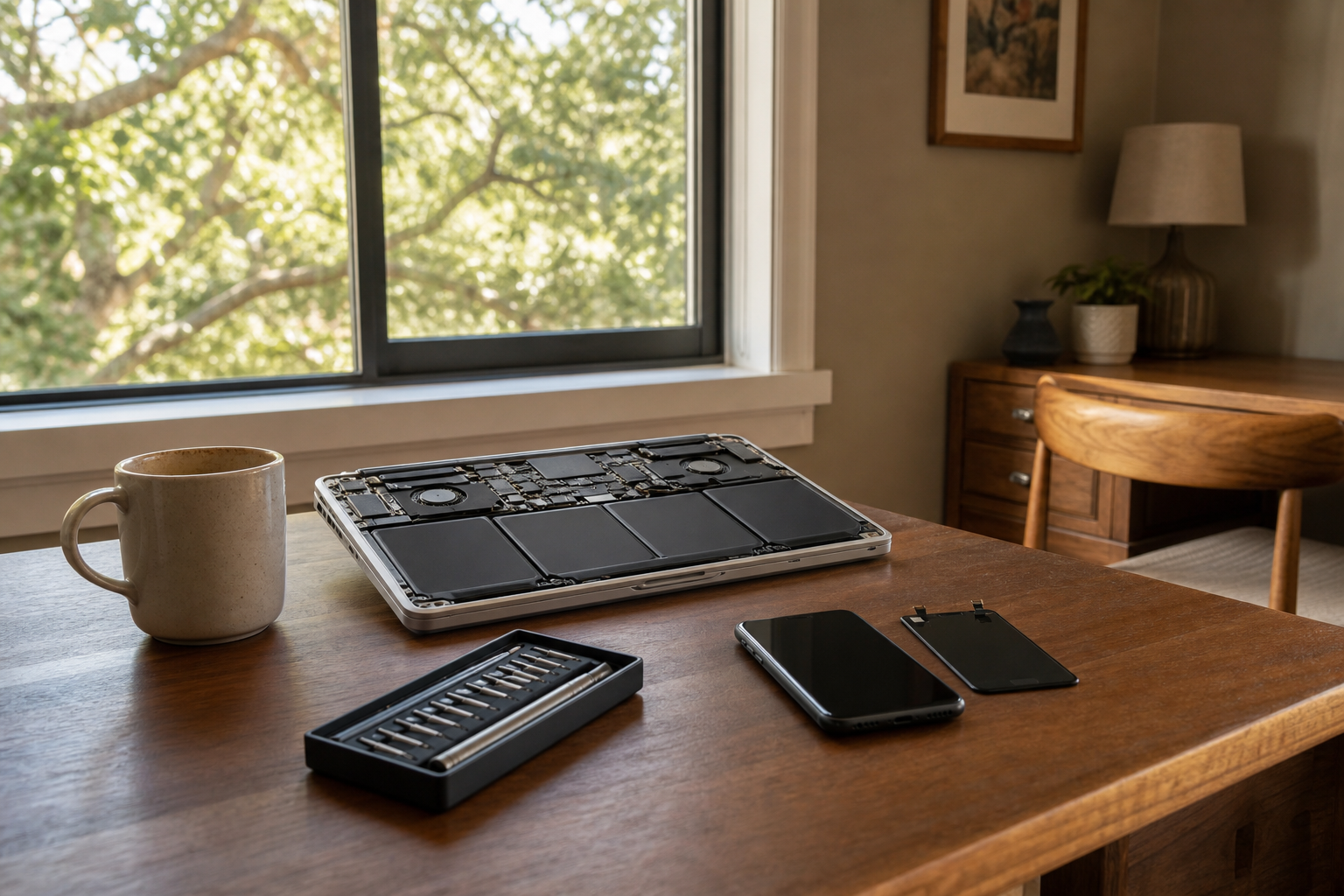
Texas's electronics right-to-repair law, House Bill 2963, took effect on September 1, 2026, and it changes how Austin households can get phones, laptops, and tablets fixed, though the fine print matters a lot more than the headlines suggest.
I run a residential tech-support business here in Austin, and the "you can finally fix your own phone" story has come up in almost every conversation this week. FOX 7 Austin, KSAT, and Houston Public Media all ran it in their September 1 roundups of new Texas laws. The excitement is fair. The law is real, it passed the Legislature 130-0 in the House and 31-0 in the Senate, and Texas is now the ninth state with an electronics repair law on the books. But if you walk into a repair shop today expecting the rules to have changed for the iPhone in your pocket, you are going to be disappointed. Here is what the law does, what it does not do, and what I would actually do about it as a homeowner.
What the Texas right to repair law requires
HB 2963 tells manufacturers of "digital electronic equipment" with a wholesale price of at least $50 that they have to make three things available to both device owners and independent repair shops, on fair and reasonable terms:
- Replacement parts. The same parts the manufacturer already ships to its authorized repair network.
- Tools. Any special tool, fixture, or diagnostic software an authorized tech would use for the job.
- Documentation. Service manuals, schematics, and repair guides.
The documentation obligation has a shelf life tied to the price of the device. For products that wholesale between $50 and $99.99, the manufacturer has to keep repair documentation available for at least three years after the model first goes on sale. For anything over $100, which is every phone, laptop, and tablet you care about, it is seven years.
That covers smartphones, laptops, tablets, cameras, and speakers. It does not cover motor vehicles, medical devices, farm and heavy equipment, major home appliances, alarm and life-safety systems, video game consoles, or equipment used in critical infrastructure. If you were hoping this would help with a washing machine or a PlayStation, it will not.
The catch: it only applies to devices first sold after September 1, 2026
This is the part the headlines skipped, and it is the part that matters most for the next year or two.
The law applies only to covered equipment that a manufacturer first made available for sale in Texas on or after September 1, 2026. Devices already on the market before that date are not covered. Your current iPhone, your kid's school Chromebook, the 2023 MacBook Air on the kitchen counter: none of those get new rights under this law.
On top of that, manufacturers have up to one year after a product's first Texas sale to make the parts, tools, and documentation available. So realistically, the first generation of devices to be fully covered is whatever launches this fall, and the parts and manuals for those may not be required to show up until late 2027.
Apple's "Surprise and shine" event is this Wednesday, September 9, and the iPhone 18 Pro is expected to be the headliner. If you buy one, you will own one of the first devices the Texas law fully applies to. That is genuinely a good thing. It just is not a today thing.
What the law does not do
A few limits worth knowing before you get into an argument with a repair counter:
- No ban on parts pairing. Oregon and Colorado prohibit manufacturers from using software to reject a part that was not installed through their own channel. Texas does not. So a screen or battery swapped with a third-party part can still trigger "unknown part" warnings or reduced features on some devices.
- No security overrides. Manufacturers are not required to hand over trade secrets, source code, or tools that bypass security features.
- No private lawsuits. Enforcement belongs to the Texas Attorney General only. The AG has to send written notice and give a manufacturer 30 days to fix the problem before it can be treated as a deceptive trade practice. You cannot sue a manufacturer yourself under this chapter.
In plain terms: this law improves the supply of parts and information for independent shops over the next few years. It does not put a repair manual in your hands tomorrow.
Repair or replace? How I decide for Austin clients
The most useful thing about this law is that it changes the math on keeping a device longer. U.S. PIRG estimates that Texas households would save around $382 a year if electronics lasted 50 percent longer through repair. From what I see on service calls around Austin, that number is not crazy. Most "dead" devices I get called about have one failed component, not a failed device.
Here is the checklist I run before anyone spends money:
- Get a diagnosis before you decide. A laptop that will not boot is usually a drive, a battery, or a corrupted update, not a dead board. A phone that dies at 2 pm needs a battery, not a $1,200 upgrade. Our device troubleshooting and repair visits start with a real diagnosis so you know what you are actually fixing.
- Back up first, always. Any repair that touches storage, and plenty that do not, can wipe a device. If your photos live only on your phone, fix that before anyone opens it. Our data backup and recovery setup takes about an hour and runs automatically afterward.
- Keep proof of purchase for anything you buy this fall. The law only covers devices first sold in Texas on or after September 1, 2026, and the documentation clock starts at the model's first sale. A receipt with a date is how you prove a device qualifies if you ever need to lean on the law.
- Rule out the software side. A surprising share of "slow, hot, and dying" laptops in Austin are fine hardware choked by startup bloat, full drives, and stacked antivirus products. A software performance tune-up is often the whole fix and costs a fraction of a repair.
- Use the free local options for the small stuff. Austin Resource Recovery runs free Fix-It Clinics with volunteer repair coaches. They are great for speakers, small appliances, and cables, but note they exclude computers, phones, and tablets. For those, you still need a shop or a house call.
A note on where to find real repair information today
Even before this law, a few manufacturers had started opening up. Apple's Self Service Repair program sells genuine parts and rents tools for recent iPhones and Macs, and publishes repair manuals. Samsung has a similar program. iFixit hosts community-written guides for almost everything. The Texas law will push more manufacturers in that direction, and it puts a legal floor under the ones already doing it.
What I tell clients: if you are comfortable with small screws and patience, a battery swap on a laptop is a reasonable Saturday project with the right guide. Screens, charging ports, and anything involving adhesive or a waterproof seal are where a DIY attempt usually ends with a second, more expensive repair.
The bottom line for Austin homeowners
Texas's right to repair law is a real win, but it is a slow one. It rewards the devices you buy from here on, not the ones you already own. In the meantime, the practical advice has not changed: diagnose before you replace, back up before you repair, and do not let a single failed part talk you into a whole new device.
If something in your house is limping along and you want a straight answer on whether it is worth fixing, book a visit or send us a note. We come to you anywhere in the Austin area, and we will tell you if the honest answer is "just replace it."